



Running a small farm has taught me one thing very quickly: every dollar matters.
Fertilizer can be one of those costs that keeps coming back. You buy it, use it, and then you need more. When prices go up, your farm budget feels it.
That is one reason I became so interested in red wigglers fertilizer.
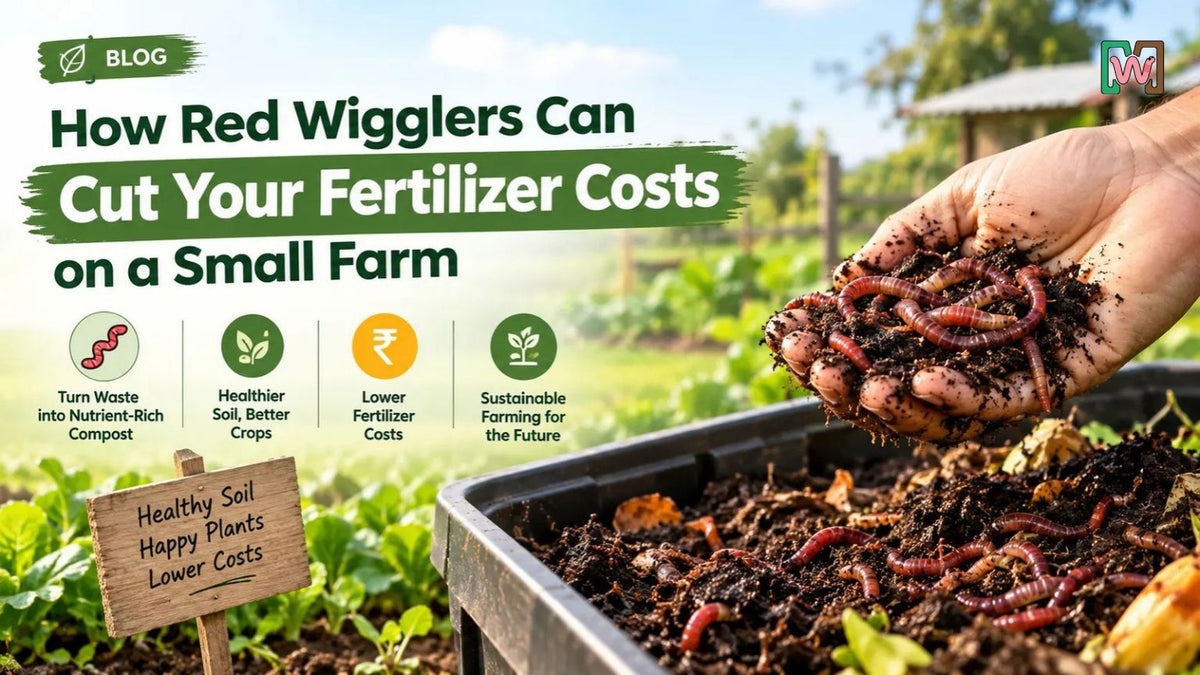
Red wigglers do not make a bag of fertilizer in the same way a factory does. Instead, they help turn food scraps, manure, plant material, and other organic matter into worm castings. These castings can be used as a soil amendment and source of plant nutrients.
For a small farm, that can be a smart way to recycle materials you already have while reducing how much outside fertilizer you need.
In this guide, I will explain how I use red wigglers, what worm castings can do for soil, where the real savings can come from, and when buying worms or castings makes financial sense.
Why Fertilizer Costs So Much Right Now?
Small farmers feel every price jump. USDA's September 2026 farm income forecast says U.S. farmers will spend $39.6 billion on fertilizer, lime, and soil conditioners in 2026. That is up $5.3 billion, or 15.3 percent, from 2025.
Looking back, USDA's Economic Research Service reports that nitrogen fertilizer prices hit record highs in 2022. Anhydrous ammonia went above $1,600 per ton. Urea passed $1,000 per ton. Prices came down after that, but they stayed higher than before 2021.
So I understand why so many growers are looking at natural and organic fertilizers. They want fewer surprises at the checkout. A worm bin is one way to get there, because you make part of your fertilizer at home.
What Is Red Wigglers Fertilizer?
When people search for red wigglers fertilizer, they are usually talking about the castings produced by red wiggler worms.
Red wigglers, commonly associated with Eisenia species, feed on decomposing organic material. As food passes through their digestive system, it becomes worm castings.
I think of castings as a recycled soil amendment.
They can contain:
- Organic matter
- Plant nutrients
- Beneficial microorganisms
- Humic substances
- Minerals in forms that may be useful to plants
The exact nutrient content can vary based on what the worms eat and how the system is managed.
That last point matters.
Worm castings are not all the same.
Must Read : Truth About “Pure Red Wigglers”: Why I Changed How I Talk About My Worms
Why I Like Worm Castings on a Small Farm
I do not look at vermicomposting as a magic replacement for every fertilizer.
I look at it as one tool.
My goal is to recycle as much farm waste as I can and turn it into something useful.
Instead of sending organic material away, I can use worms to help process it.
This can create several benefits:
- Less organic waste
- More soil organic matter
- A useful soil amendment
- Less dependence on purchased inputs
- A renewable farm resource
The biggest savings often come from recycling materials that you already have.
How rich are castings? The University of Georgia says well-rotted vermicompost usually holds:
- 1.2 to 4 percent nitrogen
- 0.9 to 1.7 percent phosphorus
- 1.5 to 2.5 percent potassium
A bag of fertilizer labeled 10-10-10 has 10 percent of each. So castings are milder. That is not a bad thing. Castings also add organic matter to your soil, and that helps your soil hold water and stay loose.
How Red Wigglers Can Reduce Fertilizer Costs
This is where the idea gets interesting.
If I already have:
- Vegetable scraps
- Crop residue
- Aged manure
- Shredded cardboard
- Other safe organic materials
I can use them as worm feed.
The worms process that material, and I harvest the castings.
That means some of the nutrients that were already on my farm stay on my farm.
I am not creating nutrients from nothing.
I am recycling them.
Red Wigglers Fertilizer vs. Store-Bought Organic Fertilizer
There is a place for natural and organic fertilizers.
Commercial organic fertilizer can be useful when I need a specific nutrient or a known analysis.
For example, I may need more nitrogen, phosphorus, or potassium based on a soil test.
Worm castings are different.
They are primarily a soil amendment and biological input. Their nutrient content can be lower and less predictable than a concentrated fertilizer.
That is why I would not automatically replace every fertilizer application with castings.
Instead, I use them as part of a larger soil-building plan.
Must Read : Where Can I Buy Red Wiggler Worms Online?
The Real Cost of Organic Fertilizer
The price of organic fertilizer is not the only cost I consider.
I also look at:
- Shipping
- Storage
- Application
- Labor
- Frequency of use
- Nutrient concentration
A concentrated fertilizer can deliver a lot of nutrients in a small amount.
Worm castings usually contain nutrients at lower concentrations.
So if I compare them only by the price of a bag, I may get the wrong answer.
The better question is:
How much does it cost me to improve my soil and supply the nutrients my crops need?
How I Calculate My Red Wigglers Fertilizer Cost
If I want to know whether vermicomposting will save my farm money, I start with simple numbers.
I calculate:
Cost of worm system + bedding + feed + labor = total vermicomposting cost
Then I compare that with:
Cost of purchased fertilizer + shipping + application = fertilizer cost
I also consider the value of materials I would otherwise have to dispose of.
For example, if my farm produces a lot of organic waste, that waste already has value.
The worms helped me recover it.
Can Worm Castings Replace Fertilizer?
This is an important question.
Usually, I would not say that worm castings should replace every fertilizer.
A soil test is the better starting point.
If my soil is low in a certain nutrient, I need to know that before deciding what to add.
The United States Department of Agriculture and university extension programs recommend using soil testing to guide nutrient management.
That keeps me from adding nutrients that my soil does not need.
Must Read : Red Wiggler Reproduction
Worm Castings Can Help Build Better Soil
One reason I value castings is that farming is not just about feeding today's crop.
I want healthy soil for the next crop, too.
Organic matter can help improve:
- Soil structure
- Water holding
- Nutrient cycling
- Microbial activity
Research on vermicompost has found that it can support plant growth when used properly.
The results can vary by crop, soil, and vermicompost product.
That is why I prefer realistic claims over promises.
How I Use Red Wigglers on a Small Farm
My basic process is simple.
Step 1: Collect safe organic material
I gather suitable plant material and other worm-safe feedstocks.
Step 2: Prepare the bedding
Red wigglers need moist bedding with good airflow.
Step 3: Add the worms
I introduce healthy red wigglers into the prepared system.
Step 4: Feed lightly
I do not dump a huge pile of food into the bin.
I let the worms and microorganisms keep up.
Step 5: Watch moisture
The bedding should be moist but not soaked.
Step 6: Harvest castings
Once the material has been processed, I separate the finished castings.
Step 7: Use the castings
I can add them to garden beds, potting mixes, or around established plants based on my soil and crop needs.
Red Wigglers Fertilizer for Sale: Should You Buy Worms or Castings?
This is where many new farmers get confused.
If I search for red wigglers fertilizer for sale, I may find two very different products:
- Live red wiggler worms
- Finished worm castings
They serve different purposes.
If I want to start producing my own castings, I need live worms.
If I want an immediate soil amendment, I may want finished castings.
I always check exactly what I am buying before comparing prices.
The Hidden Farm Savings
The biggest savings may not come from fertilizer alone.
Think about what happens to farm waste.
Without a worm system, I may need to:
- Haul it
- Store it
- Compost it
- Pay someone to remove it
With a well-managed worm system, that material can become a farm input.
So I am saving on waste management while producing a useful soil amendment.
That is a double win.
When Worm Castings May Not Save Money
I also want to be honest about this.
Vermicomposting is not automatically cheaper.
There are costs for:
- Worms
- Bins
- Bedding
- Labor
- Water
- Space
- Harvesting
- Processing
If I buy expensive equipment and only process a tiny amount of material, my savings may be small.
The system makes the most financial sense when I have a steady supply of suitable organic material and enough space to manage it.
My Simple Rule for Small Farms
I ask myself three questions:
Do I have organic waste?
Do I have space for worms?
Do I need a long-term soil-building system?
If the answer is yes to all three, vermicomposting may be worth exploring.
Final Thoughts
I do not see red wigglers as a miracle fertilizer.
I see them as tiny farm workers.
They help me recycle organic material and turn it into worm castings that can become part of a healthy soil management plan.
For a small farm, that can matter.
If I can keep nutrients on my property, reduce waste, improve soil, and lower my need for some purchased inputs, I am moving in the right direction.
The key is to use worm castings wisely.
Start with a soil test. Know what your crops need. Track your costs. And do not assume that every bag of red wigglers fertilizer has the same nutrient value.
That is how I would approach vermicomposting as a real farm investment.





Dejar un comentario
Todos los comentarios se revisan antes de su publicación.
Este sitio está protegido por hCaptcha y se aplican la Política de privacidad de hCaptcha y los Términos del servicio.