



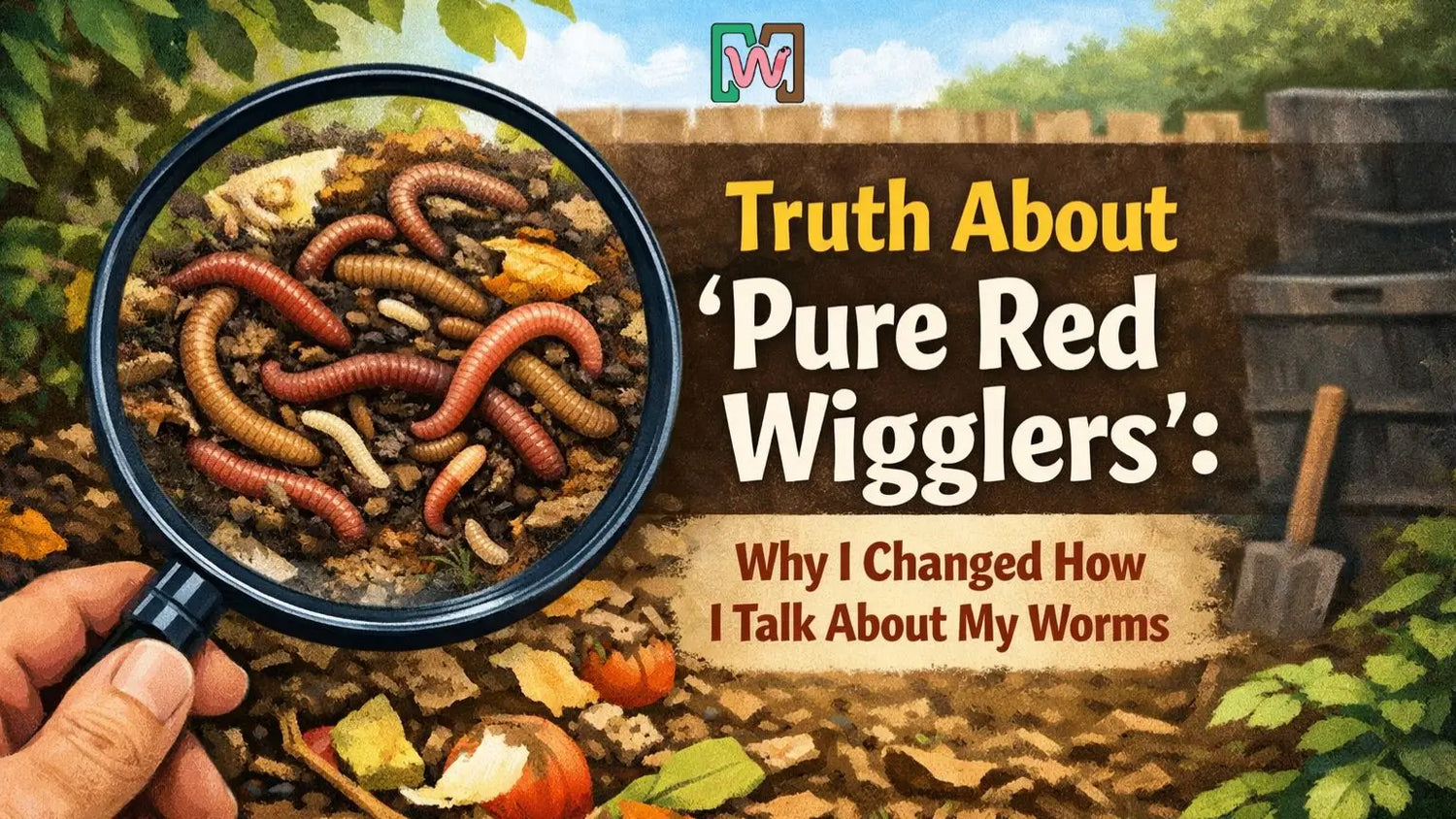
Eisenia fetida and Eisenia andrei are both red wiggler composting worms. While they are considered different species, they cannot be reliably identified without DNA testing. Because DNA testing is not practical for every worm, responsible worm farmers classify their worms based on best-known stock—not guaranteed species.
Why I’m Writing This
I’m going to be real with you.
I didn’t wake up one day and decided to write a science blog.
- I went down this rabbit hole because another grower tried to discredit me.
They questioned how I market my worms. They made it sound like I didn’t know what I had.
And I had two choices:
- Ignore it
- Or dig into the science and tell you the truth
You already know which one I chose.
Because my business is built on one thing:
Honesty and integrity
What Are Red Wigglers?
Let’s start here.
Red wigglers are composting worms. They are used for:
- Worm bins
- Composting
- Gardening
- Soil health
The two names you will hear are:
- Eisenia fetida
- Eisenia andrei
Both are red wigglers.
Both are used all over the world.
Both work extremely well in real composting systems.

Are Eisenia fetida and Eisenia andrei Different?
Yes. Scientifically, they are considered different species.
Research from Jorge Domínguez helped confirm that they are genetically distinct.
That sounds simple.
And this is where it gets complicated.
You Cannot Reliably Tell Them Apart
I am going to say this clearly.
You cannot reliably identify Eisenia fetida and Eisenia andrei just by looking at them.
Not by:
- Color
- Striping
- Size
- Shape
- Tail color
Even experienced researchers have misidentified them without testing.
That means if someone tells you they can visually guarantee the species, that is not based on science.
Must Read : Red Wigglers for Sale: What to Know Before You Buy Composting Worms
The DNA Testing Truth
Now you might think:
“Okay, just DNA test them.”
Here is the problem.
DNA testing kills the worm.
And it only works on a small sample.
So even if someone says:
“My worms are DNA tested”
What that really means is:
- A few worms were tested
- Not every worm
- Not every generation
It is not possible to test every worm in a system without destroying the population.
"Even Top Suppliers Cannot Guarantee Species"
This part surprised me too.
Even large biological suppliers like Carolina Biological Supply Company do not guarantee species without DNA testing.
They rely on:
- Known stock
- Visual traits
- Historical classification
Not full genetic confirmation of every worm.
So if major research suppliers cannot guarantee it…
No worm farm can either.
Can These Worms Mix?
Yes. And this matters.
Eisenia fetida and Eisenia andrei can:
- Live together
- Mate in some cases
- Share the same environment
They often prefer their own type, and some cocoons may not hatch when mixed.
Over time, most worm bins become mixed populations.
Let’s Clear This Up: These Are NOT Blue Worms
There is another confusion I hear.
People think red wigglers are the same as blue worms.
They are not.
Blue worms are:
- Perionyx excavatus
They behave very differently:
- More active and erratic
- Strong smell when disturbed
- Prefer warmer climates
- More likely to escape
Red wigglers are stable and predictable.
The “Pure Worm” Marketing Problem
This is where I need to be direct.
Some sellers say things like:
- “100% pure Eisenia fetida”
- “Guaranteed species”
And they do not explain the full truth.
Because:
- DNA testing kills worms
- Only small samples can be tested
- Entire populations cannot be verified
So those claims are based on assumption, not full proof.
Must Read : How to Choose the Best Composting Worms (Beginner Guide From a Commercial Worm Farmer)
Why I Changed My Wording
This is important to me.
I used to separate them.
Then I asked myself:
“Can I prove this 100%?”
And the answer was no.
So I changed how I speak about my worms.
I now call them:
Pure Red Wiggler Composting Worms
Not to hide anything.
And to stay honest.
What Actually Matters in Worm Farming
Here is what I focus on instead.
✔ Healthy worms
✔ Strong reproduction
✔ Reliable composting
✔ Real-world performance
✔ Honest communication
Because this is what impacts your results.
Not the label.
Are Eisenia fetida Better Than Eisenia andrei?
No.
They are not better or worse.
They are so similar that in real systems, the difference does not matter for most people.
Both:
- Break down food waste
- Reproduce quickly
- Thrive in worm bins
Your setup matters more than the species name.
My Promise to You
I built my system from the ground up.
I grew it step by step.
And I will not risk trust for marketing words.
If I cannot prove something, I will not claim it.
That matters more to me than sounding impressive.
Bottom Line
✔ Eisenia fetida and Eisenia andrei are both red wigglers
✔ They are different species scientifically
✔ They cannot be reliably identified by sight
✔ DNA testing is required for certainty
✔ DNA testing is not practical at scale
✔ Even major suppliers cannot guarantee species
✔ These are not blue worms
❌ “Pure species” claims cannot be fully verified
Final Word
If someone questions how I do things, that is fine.
I have done the research.
I have done the work.
And I stand on what is real.
Not hype.
Not guesses.
Not marketing tricks.
Just real worms. Raised right.





Leave a comment
All comments are moderated before being published.
This site is protected by hCaptcha and the hCaptcha Privacy Policy and Terms of Service apply.