



A customer called me a while back with a question I had never been asked before. She had been feeding her bin every Sunday morning for about six months, and she wanted to know whether her worms had figured out the schedule. Were they coming up to the surface because they knew she was on her way?
It is a sweet question. The answer is no, but the real answer is more interesting than a flat no.
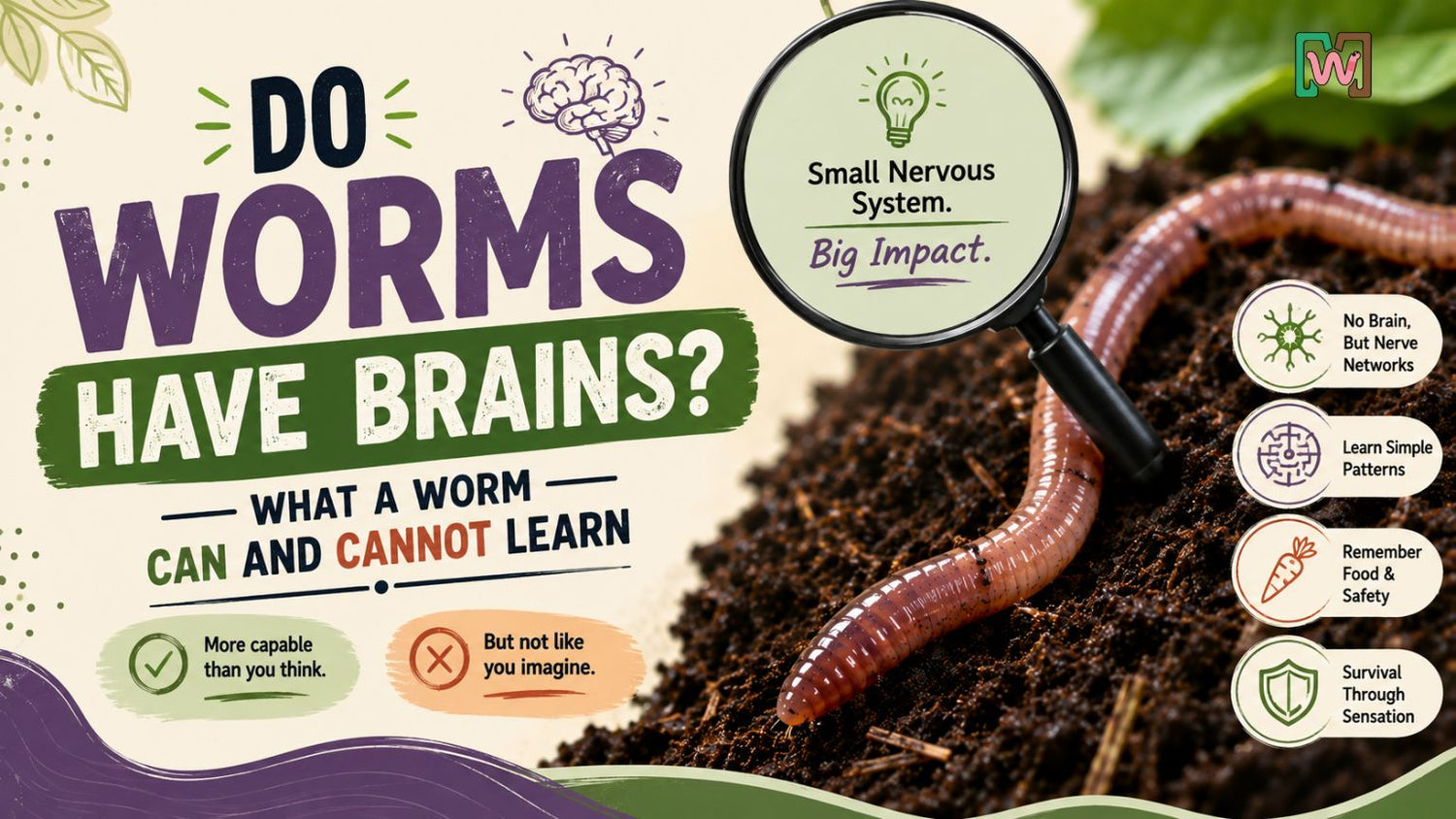
Do worms have brains? Yes. Earthworms have a small, simple brain. It is nothing like ours, and what it can and cannot do explains a lot about worm behavior in a bin.
Do Worms Have Brains?
Yes. An earthworm has one brain, near the front of its body, sitting just above the throat.
Scientists call it the cerebral ganglion. That word just means a bundle of nerve cells. It is two small lobes joined together, only a few millimeters long. There is no skull around it.
According to WormWatch, the earthworm brain is a fused pair of nerve bundles located near the front of the worm, connected to large nerve fibers that run the length of the body.
So the worm has a brain. It just has a very small one with a very specific job.
Must Read : Do Worms Feel Pain? An Honest Look at What Science Knows
How the Whole System Fits Together
The brain is only one piece. The full setup has three parts.
The brain (cerebral ganglion). Sits near the front. Takes in signals about light, moisture, chemicals, and touch, and decides the general direction the worm should go.
The nerve cord. A single cord running the length of the worm along its underside, like a telephone line from front to back.
Segment ganglia. Each ring of the worm's body has its own tiny nerve bundle. These handle the local muscle work in that segment.
Think of it like a small crew. The brain says "go that way." The nerve cord passes the message down the line. Each segment's ganglion handles its own stretching and squeezing so the whole body moves in a smooth wave.
This is why a worm moves so evenly. No single part is controlling all hundred-plus segments at once.
Does a Worm Have More Than One Brain?
No. A worm has one brain and many nerve bundles, and those are not the same thing.
I hear the "multiple brains" idea a lot, and I understand where it comes from. Because every segment has its own little nerve center, and because a damaged worm can keep moving for a while, it looks like there are backup brains in there. There are not.
The two-brain idea comes from the same place. The cerebral ganglion has two lobes side by side, joined in the middle. Two lobes, one brain. Your own brain has two halves too.
Must Read : Are Worms Insects? Why the Answer Matters When You Buy Worms
What a Worm Can Actually Learn
Here is where it gets interesting, and here is the answer to that customer's question.
Worms cannot learn a schedule. They have no sense of Sunday. They cannot plan, remember a person, or expect something to happen later.
But worms are not blank either. They show a very basic kind of learning called habituation. That means if the same harmless thing keeps happening, they stop reacting to it.
You can see it yourself. Tap the side of a bin. The worms near the surface will flinch. Tap it again every few seconds. By the tenth tap, most of them stop reacting. They have not decided you are friendly. Their nervous system has just stopped treating that vibration as worth a response.
That is the ceiling of worm learning. Stop reacting to boring things. Nothing beyond it.
So why did her worms come up on Sunday mornings? Because there was food near the surface from the week before, the bedding was damp, and the temperature was comfortable. Conditions, not memory.
What the Brain Actually Controls
The worm's brain handles a short list of jobs, and it handles them well.
- Sensing light and steering away from it
- Following chemical trails toward food
- Sensing moisture and moving toward damp
- Reacting to vibration and pressure
- Coordinating the muscle waves that move the body
- Controlling feeding
Notice what is not on that list. No problem solving. No planning. No recognizing individuals. A worm never needs to do any of those things, so it never developed the hardware for them.
Must Read : Do Worms Have Eyes? How Earthworms Sense Light Without Them
Why a Simple Brain Is Enough
I think people expect worms to be smarter than they are because we judge animals by how much they act like us. A worm's life just does not require much thinking.
A worm does not hunt. It does not build a nest. It does not raise its young or defend a territory. It eats decaying material, moves through soil, avoids drying out, and reproduces.
For that life, a few millimeters of nerve tissue is plenty. Earthworms have been doing it successfully for a very long time.
What This Means for How I Handle Worms
Knowing that a worm runs on reflexes rather than thought changes how I manage bins in a few concrete ways.
Worms cannot adapt to a bad bin. A smarter animal might learn to work around a problem. A worm cannot. If the bedding goes acidic or overheats, the worm has one response, which is to try to leave. It will not tough it out or wait for things to improve. That is why worms crawling out is always worth investigating immediately.
Consistency matters more than routine. Since worms cannot anticipate anything, there is no benefit to feeding at the same time each week. What matters is that conditions stay steady. Moisture, temperature, and pH are what the worm actually responds to.
Rough handling has no upside. A worm cannot learn to tolerate being dropped or squeezed. Every rough handling is just damage with no adjustment period.
Behavior is a readout, not an opinion. When worms bunch in one corner, they are not preferring that corner. Something is chasing them out of the rest of the bin. Reading worm behavior as a sensor reading rather than a choice is the fastest way to catch problems early.
Can a Worm Survive Without Its Brain?
Generally, no. The brain sits in the front segments, and damage there is usually fatal.
This connects to the old myth that cutting a worm in half gives you two worms. It does not. The front half, if the cut is far enough back and the brain and hearts are intact, may survive and regrow some tail. The back half has no brain, no mouth, and no hearts. It will move for a while because the segment ganglia keep firing, and then it will die.
Movement after a cut is reflex, not life continuing.





Dejar un comentario
Todos los comentarios se revisan antes de su publicación.
Este sitio está protegido por hCaptcha y se aplican la Política de privacidad de hCaptcha y los Términos del servicio.