



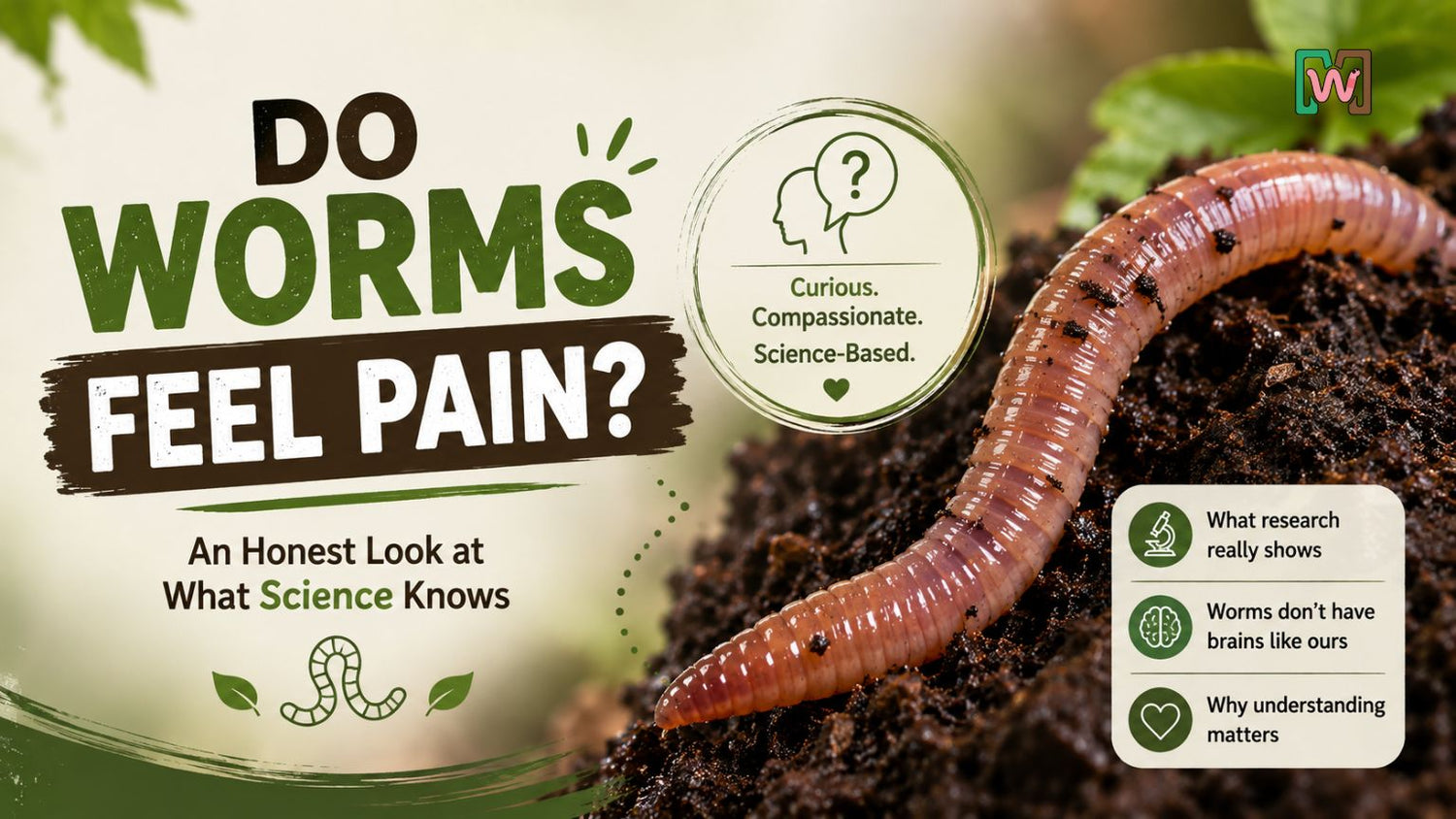
I do farm visits for school groups, and there is always one child who asks for it. Usually quietly, usually while holding a worm very carefully in both hands.
"Does it hurt him?"
I have never wanted to give that child a lazy answer. So I went and read what researchers actually say, and I want to lay it out honestly here, including the parts where science does not have a firm answer yet.
Do worms feel pain? Worms clearly detect harm. Whether they suffer the way you and I do is something scientists cannot currently confirm. Those are two different questions, and most articles blur them together.
Two Different Things Get Called "Pain"
To answer this properly, you have to separate two ideas that sound like one.
Detecting harm. Scientists call this nociception. It means the body has sensors that pick up damage, heat, or pressure and trigger a response. It is automatic. It happens whether or not anyone is aware of it.
Suffering. This is the felt, conscious, unpleasant part. The distress. The part that makes pain matter to us emotionally.
In humans these two arrive together, so we treat them as one thing. In simple animals they may come apart.
Earthworms clearly have the first. Whether they have the second is the open question.
What We Know For Certain
There is solid agreement on these points.
Worms have a working nervous system. A small brain near the front, a nerve cord running the length of the body, and nerve bundles in each segment. Signals travel fast.
Worms detect and respond to harm. Touch a worm with something hot, sharp, or dry and it reacts immediately. It pulls away, contracts, and tries to escape.
Worms actively avoid bad conditions. Given a choice, worms move away from bright light, dry soil, high heat, and harmful chemicals. That avoidance is consistent and reliable.
Some worms release protective substances when damaged. Red wigglers in particular produce a fluid when handled roughly. That is a defensive response.
None of that is in dispute. A worm is absolutely not a plant.
Must Read : Are Worms Insects? Why the Answer Matters When You Buy Worms
What We Do Not Know
Here is where honest reporting matters.
Scientists cannot currently confirm that earthworms experience pain the way animals with complex brains do. Not because anyone has proven they do not, but because we do not have a good way to test for the felt experience of something that cannot tell us about it.
Researchers usually look for indirect evidence of suffering, such as:
- Long-term behavior changes after an injury
- Evidence of learning to avoid a specific place where harm occurred
- Trade-offs, like an animal giving up food to escape something unpleasant
- Complex brain activity associated with distress
Earthworms have a very simple nervous system, and evidence of these markers is limited. Their reactions look like reflexes rather than considered responses.
So the fair summary is this: worms detect damage, and we cannot say whether it feels like anything to them. Anyone who tells you the answer is a confident yes or a confident no is going past what the evidence supports.
Movement Is Not Proof of Suffering
The strongest reason people believe worms feel pain is that an injured worm thrashes. It looks awful, and I understand the reaction.
But movement alone is not evidence of felt pain. A worm's segments each have their own nerve bundle, and those keep firing on their own after damage. That is why a cut worm keeps moving for a while, and it is also why a worm continues to wriggle after its brain is gone.
Reflex, not necessarily distress.
I say this not to dismiss the concern but because the reasoning matters. If we are going to treat worms carefully, it should be for good reasons rather than a misread of what we are looking at.
Must Read : Do Worms Have Eyes? How Earthworms Sense Light Without Them
The Fishing Question
Many people arrive at this question because of bait. It is a fair thing to think about, and I sell fishing worms, so I am not going to dodge it.
What we can say: a hooked worm responds immediately and tries to escape. That is a harm response and it is real.
What we cannot say: whether the worm is experiencing that as suffering.
Where that leaves it, in my view, is that the uncertainty itself is worth taking seriously. When you are not sure whether something can suffer, erring toward care costs very little. Handling worms gently, keeping them cool and damp, and not leaving them out in the sun are all easy habits.
I am not going to tell an angler what to do. I will say the question deserves better than a shrug.
Does Cutting a Worm in Half Create Two Worms?
No, and this myth causes real harm because it makes people think cutting a worm is harmless or even helpful.
Here is what actually happens. The front portion, if the cut is far enough back and the brain and hearts survive, may live and regrow some of its tail. The back portion has no brain, no mouth, and no hearts. It will move for a while and then die.
You do not get two worms. Most of the time you get one damaged worm and one piece of tissue.
The same goes for a shovel through a worm in the garden. It is not a bonus. It is usually a dead worm.
Why I Handle Worms Carefully Anyway
I want to be straight about my own reasoning here, because it is not purely scientific.
Even if it turns out worms cannot suffer, careful handling is still the right call for practical reasons. Damaged worms do not eat well, do not reproduce, and often die. In a commercial operation, rough handling costs money.
And on the ethical side, I land where a lot of people do. When the evidence is genuinely uncertain about whether a living thing can suffer, treating it gently is a cheap way to be on the right side of that uncertainty.
So on my farm we:
- Handle worms with wet hands rather than dry
- Keep them out of direct sun
- Avoid dropping or squeezing
- Pack shipments with enough bedding to cushion them
- Keep bedding conditions stable so worms are not stressed in the first place
That is not sentimentality. It is how you get healthy worms and how I would want to be behaving either way.
What I Tell the Kids
When a child asks me whether it hurts, here is roughly what I say.
"He can feel that something is happening. Scientists are still figuring out whether it hurts him the way it would hurt you. So we hold him gently, just in case."
That is the truth, at a level a child can follow, and it does not require pretending to know something we do not.





Leave a comment
All comments are moderated before being published.
This site is protected by hCaptcha and the hCaptcha Privacy Policy and Terms of Service apply.