



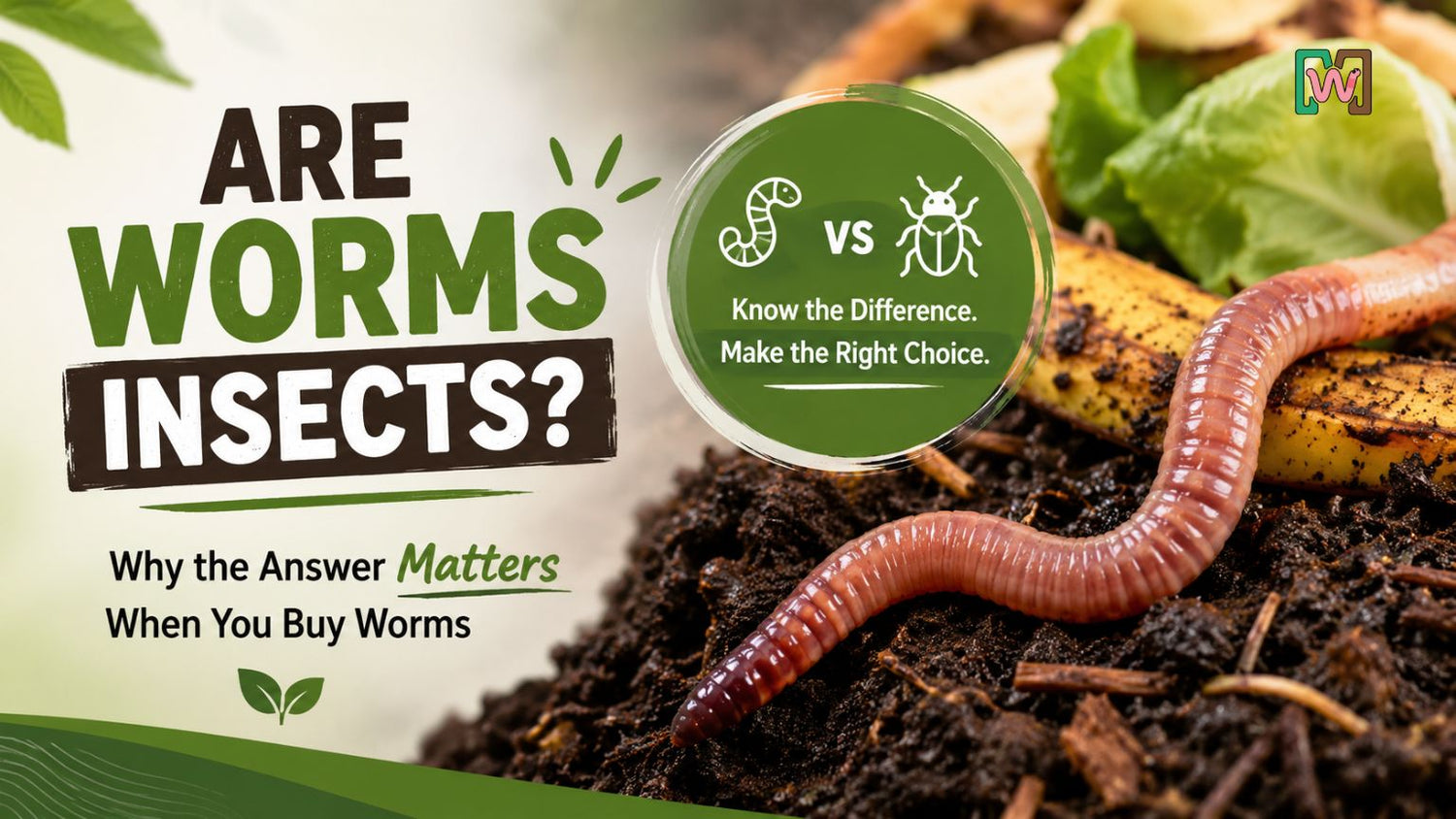
I get a phone call every few months that goes roughly the same way. Someone bought worms online for their compost bin, opened the bag, and found short tan grubs instead of long red worms. They want to know what went wrong.
Nothing went wrong with the shipping. They bought mealworms.
Mealworms are insects. Composting worms are not. They are not even distant cousins. And that mix-up costs people money and a few weeks of a stalled bin every single time.
Are worms insects? No. Earthworms and insects are separated at one of the highest levels of biological classification. Here is what that actually means, and why it is worth knowing before you order.
Are Worms Insects?
No. Earthworms are not insects.
Scientists group living things in a nested system. Near the top of that system is a level called the phylum. Splitting at the phylum level means two groups went their separate ways very early and share almost nothing structurally.
- Earthworms belong to the phylum Annelida, meaning segmented worms
- Insects belong to the phylum Arthropoda, alongside spiders, crabs, and shrimp
They are both animals and both invertebrates, meaning neither has a backbone. That is where the similarity stops.
The Checklist That Settles It
An animal has to have specific features to count as an insect. There is no judgment call involved.
To be an insect, an animal must have:
- Six legs
- Three body sections: head, thorax, abdomen
- A hard external skeleton
- One pair of antennae
- Usually wings at some stage of life
An earthworm has:
- No legs
- One long body divided into many similar rings
- No hard shell of any kind
- No antennae
- No wings, ever
An earthworm fails every single item on the list. This is not a close call.
Must Read : Do Worms Have Eyes?
Side by Side
|
Feature |
Earthworm |
Insect |
|
Phylum |
Annelida |
Arthropoda |
|
Legs |
None |
Six |
|
Outer skeleton |
None, soft moist skin |
Hard exoskeleton |
|
Body sections |
Many similar segments |
Three distinct sections |
|
Antennae |
None |
One pair |
|
Breathing |
Through the skin |
Through openings called spiracles |
|
Hearts |
Five |
One tube-shaped heart |
|
Reproduction |
Each worm has both male and female parts |
Usually separate males and females |
|
Growth |
Grows steadily |
Molts, and many change form completely |
That breathing row is worth pausing on. An earthworm absorbs oxygen through damp skin across its whole body. An insect pulls air in through small holes along its sides connected to tubes. Those are entirely different solutions to the same problem, which is exactly what you would expect from two groups that separated a very long time ago.
Why the Confusion Happens
The mix-up is understandable. Worms and insects are both small, both live in soil and leaf litter, both crawl, and neither has bones. If you are sorting animals by "small crawling thing," they land in the same pile.
The word "worm" makes it worse. In everyday English we call a lot of unrelated things worms:
- Earthworms and red wigglers — actual annelids, what I raise
- Mealworms — beetle larvae, insects
- Waxworms — moth larvae, insects
- Silkworms — moth larvae, insects
- Inchworms — moth larvae, insects
- Grub worms — beetle larvae, insects
Notice a pattern. Most things called worms in casual speech are actually baby insects. Earthworms are the ones that genuinely are worms.
Why This Matters If You Are Buying
This is the practical reason I bother writing about taxonomy at all.
Mealworms will not compost your kitchen scraps. They are beetle larvae raised as animal feed. Put them in a worm bin and they will not process food waste into castings. They will turn into beetles.
Only certain annelids work for vermicomposting. Red wigglers and European nightcrawlers are the workhorses because they live in the top layer of decaying material rather than deep in soil. Common garden earthworms actually do poorly in bins because they want to burrow deep.
Check the scientific name before you buy. This is the reliable test. If a listing says Eisenia fetida or Eisenia hortensis, you are getting real composting worms. If it says Tenebrio molitor, that is a mealworm and it is an insect.
Fishing bait listings are the most confusing. Both earthworms and insect larvae get sold as bait, side by side, often with similar names. Look for the species name.
Must Read : Worm Anatomy Explained
Are Worms Bugs? Are They Reptiles?
Two more comparisons come up often enough to answer directly.
Bugs. In everyday speech, "bug" means any small crawling creature, and by that loose definition people call worms bugs all the time. Scientifically, a true bug is a specific group of insects called Hemiptera, which includes things like stink bugs and aphids. Earthworms are neither true bugs nor insects.
Reptiles. Snakes and worms both have long legless bodies, so young children in particular often connect them. Reptiles have backbones, lungs, and scales. Earthworms have none of the three. They are not related at all.
What Earthworms Actually Are
Rather than defining worms by what they are not, here is what they are.
Earthworms are segmented worms in the phylum Annelida. Their bodies are made of repeating rings, each with its own muscles, nerve bundle, small excretory organs, and tiny bristles called setae that grip soil so the worm can move.
Their close relatives are other annelids: leeches, and the bristle worms found in oceans. Those are the actual family.
And their job in the soil is significant. The US Environmental Protection Agency and agricultural extension services consistently point to earthworms as important contributors to soil health, mixing organic matter, improving water movement, and cycling nutrients back into a form plants can use.
That work is why I care what people put in their bins. The right animal does the job. The wrong one turns into a beetle.
Read Our Popular Blogs :
- Red Wigglers vs Earthworms: The Composter's Guide
- Do Worms Have Mouths? How Earthworms Eat Without Teeth
- Do Worms Have Brains? What a Worm Can and Cannot Learn
- Do Worms Feel Pain? An Honest Look at What Science Knows





Leave a comment
All comments are moderated before being published.
This site is protected by hCaptcha and the hCaptcha Privacy Policy and Terms of Service apply.