



Every time I uncover a worm bed or turn on the light over our sorting table, the same thing happens: the worms begin moving down into the material.
They are not seeing me. They are reacting to the sudden change from darkness to light.
So, do worms have eyes?
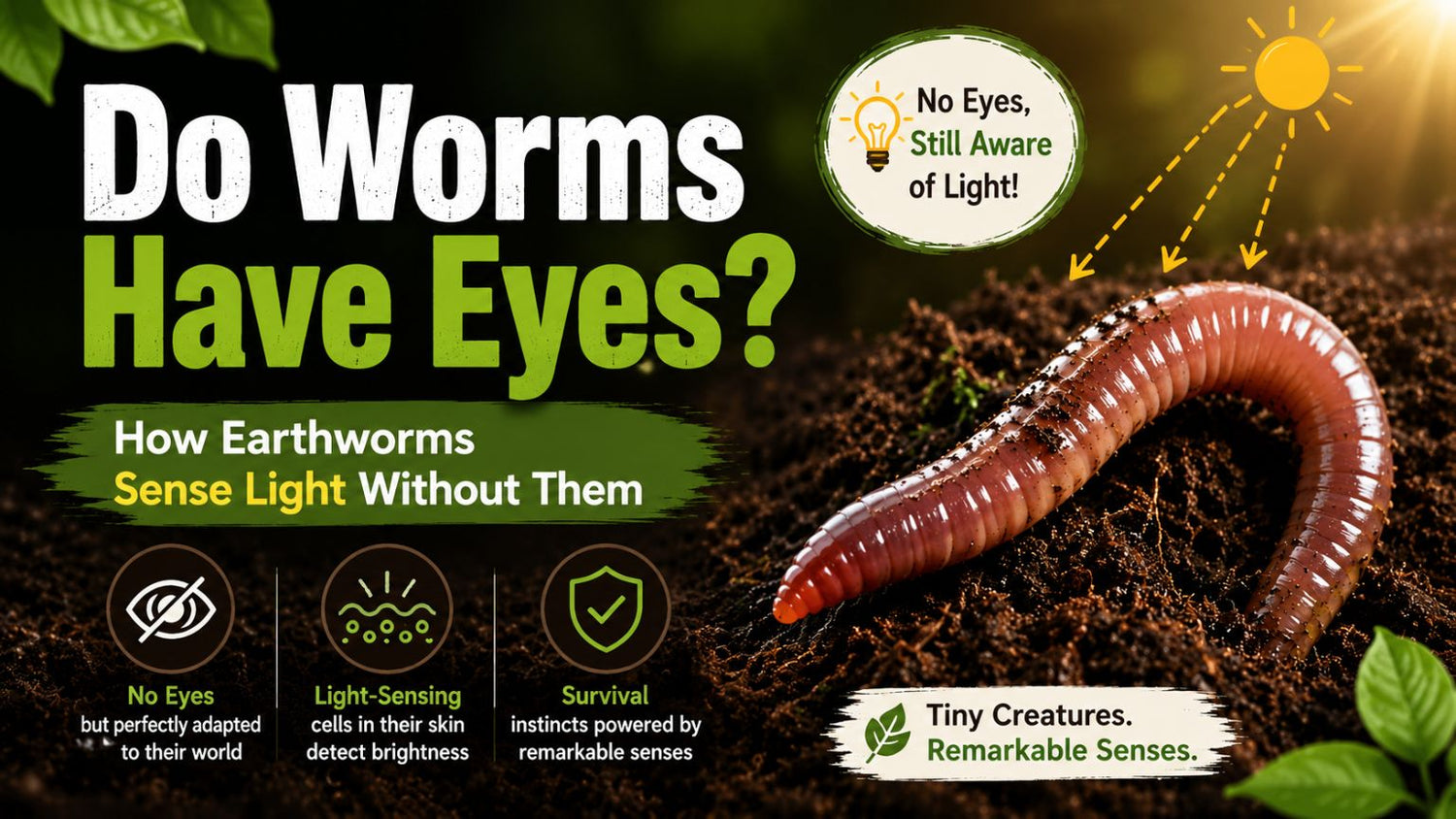
No. Earthworms do not have eyes, eyelids, or pupils. However, they have light-sensitive cells in their skin that help them detect changes in light intensity.
That simple ability helps earthworms stay underground, avoid predators, and protect their moist skin from drying out. It also gives worm farmers a useful way to separate worms from finished castings.
Here is how worms sense light, why they avoid it, and what their reaction can tell you about conditions inside your worm bin.
Do Worms Have Eyes?
Earthworms have no eyes.
Instead, they have specialized light-sensitive cells called photoreceptor cells in their skin. These cells allow a worm to detect whether its surroundings are light or dark.
The cells are especially concentrated near the front end of the worm. The front, or anterior end, is generally the most sensitive to light. The tail can also detect light, although the middle portion of the body is less sensitive.
This means an earthworm cannot see an image the way we can. It does not see you opening the bin, but it can detect that its surroundings suddenly became brighter.
Can Worms See?
Worms cannot see shapes, colors, faces, or detailed images. They do not have the eyes or visual system required to form a picture of their surroundings.
A worm can detect:
- Brightness and darkness
- Sudden changes in light
- The general direction of stronger light
- Light reaching the front or back of its body
A worm cannot see:
- Shapes
- Faces
- Objects
- How far away something is
- Movement across a room
- Detailed colors or images
That is why a worm does not react when you walk past a closed, opaque bin. However, it may react quickly when you remove the lid and expose the bedding to bright light.
The worm sensed the light change. It did not see you.
How Do Worms Sense Light Without Eyes?
Light-sensitive cells are located in the worm’s epidermis, or outer layer of skin. These cells send signals through the worm’s nervous system when the amount of light changes.
This response is called negative phototaxis. It simply means the animal moves away from light.
Earthworms do not need detailed vision underground. They only need a warning system that tells them when they may be too close to the surface.
Think of their light-sensitive cells as a built-in alarm:
Darkness usually means shelter. Bright light may mean exposure.
That is enough information to help an earthworm survive.
Must Read : Do It Yourself Worm Compost Bin: A Simple DIY Guide That Works
Why Do Worms Avoid Light?
Worms usually avoid bright light because exposure can put them in danger.
Light may mean the worm is above ground
Earthworms are built for life in soil, compost, manure, leaf litter, and other moist organic material. Bright light often means the worm is exposed on the surface.
Exposed worms can dry out
Earthworms breathe through their skin. Their skin must stay moist for oxygen and carbon dioxide to pass through it.
Bright sunlight, heat, wind, and dry air can remove moisture from a worm’s skin. If the skin becomes too dry, the worm can no longer breathe properly.
The light itself is not always the immediate danger. The heat and drying conditions that often come with direct sunlight are the bigger concern.
Predators hunt worms at the surface
Birds, chickens, frogs, lizards, and other animals eat earthworms. Moving away from light and back into the bedding helps a worm stay hidden.
For an earthworm, quickly moving down is a practical survival response.
How I Use Light When Sorting Worms and Castings
A worm’s natural response to light can help separate worms from finished castings.
On our farm, we use a trommel to separate different sizes of material. Worms and remaining material then move to the light table for additional sorting.
The light encourages the worms to move downward while we remove material from the top. This reduces the amount of finished castings left around the worms and makes them easier to weigh and handle.
If you are harvesting a small home worm bin, you can use the same behavior without commercial equipment.
How to separate worms from castings with light
- Place the finished material in several small, cone-shaped piles on a tarp or sorting table.
- Put the piles under a bright work light or in indirect daylight.
- Wait a few minutes for the worms to move away from the exposed surface.
- Gently scrape away the top layer of worm castings.
- Wait again and remove another thin layer.
- Continue until you are left with a small pile containing mostly worms.
Move the worms into fresh, prepared bedding as soon as you finish.
Do not leave exposed worms under a hot work lamp or in direct sunlight. The goal is to encourage them to move—not to overheat or dry them out.
What Worm Behavior Can Tell You About Your Bin
Worms normally move away from sudden, bright light, but their response will not always be identical. Temperature, moisture, species, health, and the brightness of the light can all affect how quickly they move.
If worms remain on the surface when you open the bin, do not automatically assume they are sick. Look at the entire situation.
Worms gathering on the surface or trying to escape may indicate:
- Bedding that is too wet
- Bedding that has become too acidic
- Overheating
- Low oxygen
- Fresh food heating or fermenting
- Chemical contamination
- A newly established bin that has not settled
- Heavy rain or changes in air pressure in an outdoor system
Light can help keep wandering worms in a new bin temporarily, but it does not correct the underlying problem.
If your worms are trying to leave, check the bedding temperature, moisture, smell, drainage, and recent feeding before adding more food.
Must Read : How to Catch Earthworms: A Simple, Proven Guide That Works
Should a Worm Bin Be Kept in the Dark?
Worms do best when they can retreat into dark, moist bedding. That does not mean the entire room must remain completely dark.
A lamp across the warehouse or a light used briefly while checking the bin usually will not harm them. Direct, continuous light shining onto uncovered bedding is more disruptive.
A few simple setup choices can help.
Use an opaque worm bin
Clear plastic allows light to enter through the sides. This may cause worms to stay closer to the center of the bin.
An opaque tote, wooden bed, or covered commercial bin gives worms more usable space.
Cover the bedding surface
Place damp cardboard, newspaper, or another breathable bedding cover directly on top of the material.
A cover helps:
- Block light
- Hold moisture
- Give worms a protected feeding area
- Reduce evaporation
- Discourage flies
The cover should be damp, not dripping wet.
Keep the lid ventilated
Worms need oxygen. Do not seal a worm bin tightly just to block light. Use a properly ventilated lid or breathable covering.
Why Do Worms Crawl Out at Night?
Worms are more likely to explore when the room is dark because light is no longer encouraging them to remain below the surface.
A few worms exploring a new bin can be normal. Large numbers climbing the walls or leaving the bin usually deserve attention.
Common causes include:
- Bedding that is too wet
- Excessive acidity
- Overfeeding
- Fermenting food
- Overheating
- Poor airflow
- Unsuitable or contaminated bedding
Leaving a light on above the bin for a night or two can help keep worms inside while they adjust. However, treat the light as a temporary management tool—not the final solution.
Correct the moisture, temperature, pH, food, or airflow problem that caused the worms to climb in the first place.
What Senses Do Worms Use Instead of Sight?
Earthworms use several types of sensory information to move through their environment.
Chemical cues
Earthworms have chemoreceptors that respond to chemicals in their surroundings. Research has shown that red wigglers (Eisenia fetida) can use odor-related chemical cues to locate certain food materials.
They do not smell with a nose as we do, but they can detect chemicals associated with food and bedding.
Touch and pressure
Sensory cells in the skin help worms detect contact, pressure, and changes in the material around them.
These senses allow a worm to move through bedding, work around obstacles, and respond when it is handled.
Vibration
Earthworms do not have ears, but they can detect vibrations traveling through soil or bedding.
This may help them respond to nearby movement or disturbance.
Moisture
Worms need moist skin to breathe, so moisture strongly influences where they gather. They generally move away from bedding that is too dry.
However, they also need oxygen. A soaking-wet, compacted bin can drive worms away even though the material contains plenty of water.
Temperature
Worms respond to temperature and will move when possible to find a more comfortable area. This is one reason I recommend checking the actual bedding temperature rather than relying only on the room temperature.
Together, light detection, chemical sensing, touch, vibration, moisture, and temperature allow worms to live successfully without eyes.
Do Baby Worms Have Eyes?
No. Baby worms hatch from cocoons without eyes, and they never develop eyes as they mature.
Hatchlings can still respond to their environment, but they are small, delicate, and easier to dry out than mature worms.
Keep cocoons and hatchlings in moist, breathable bedding and protect them from direct sunlight and excessive heat.
Must Read : What Do Worms Eat? A Detailed Guide for What To Feed Your Worms
Do Red Wigglers Have Eyes?
No. Red wigglers—including Eisenia fetida and Eisenia andrei — do not have eyes.
They detect light through light-sensitive cells in their skin, just as other earthworms do. This is why red wigglers move down when you expose a healthy worm bin to bright light.
Do European Nightcrawlers Have Eyes?
European nightcrawlers, commonly identified as Dendrobaena veneta or Eisenia hortensis, do not have eyes either.
They also detect changes in light through their skin and usually move away from bright exposure.
Final Thoughts
Worms do not have eyes, but they are not unaware of light.
Photoreceptor cells in their skin allow them to detect brightness and quickly move toward safer, darker bedding. That response protects them from drying conditions and predators—and it gives worm farmers a simple way to separate worms from finished castings.
The next time you uncover a bin and watch the worms move down, remember: they did not see you.
They felt the light change.
Related Reading
- Worm Anatomy Explained: Complete Guide to the Essential Parts of a Worm
-
How to Start a Worm Farm at Home
- Are Worms Insects? Why the Answer Matters When You Buy Worms
-
Do Worms Have Mouths? How Earthworms Eat Without Teeth
- Do Worms Have Brains? What a Worm Can and Cannot Learn
- Do Worms Feel Pain? An Honest Look at What Science Knows





Leave a comment
All comments are moderated before being published.
This site is protected by hCaptcha and the hCaptcha Privacy Policy and Terms of Service apply.