



The most common complaint I get from new worm farmers goes something like this: "I put a carrot in three weeks ago and it is still sitting there. Are my worms broken?"
The worms are fine. The carrot is the problem.
Once you understand how a worm's mouth actually works, you stop making that mistake, and your bin speeds up dramatically.
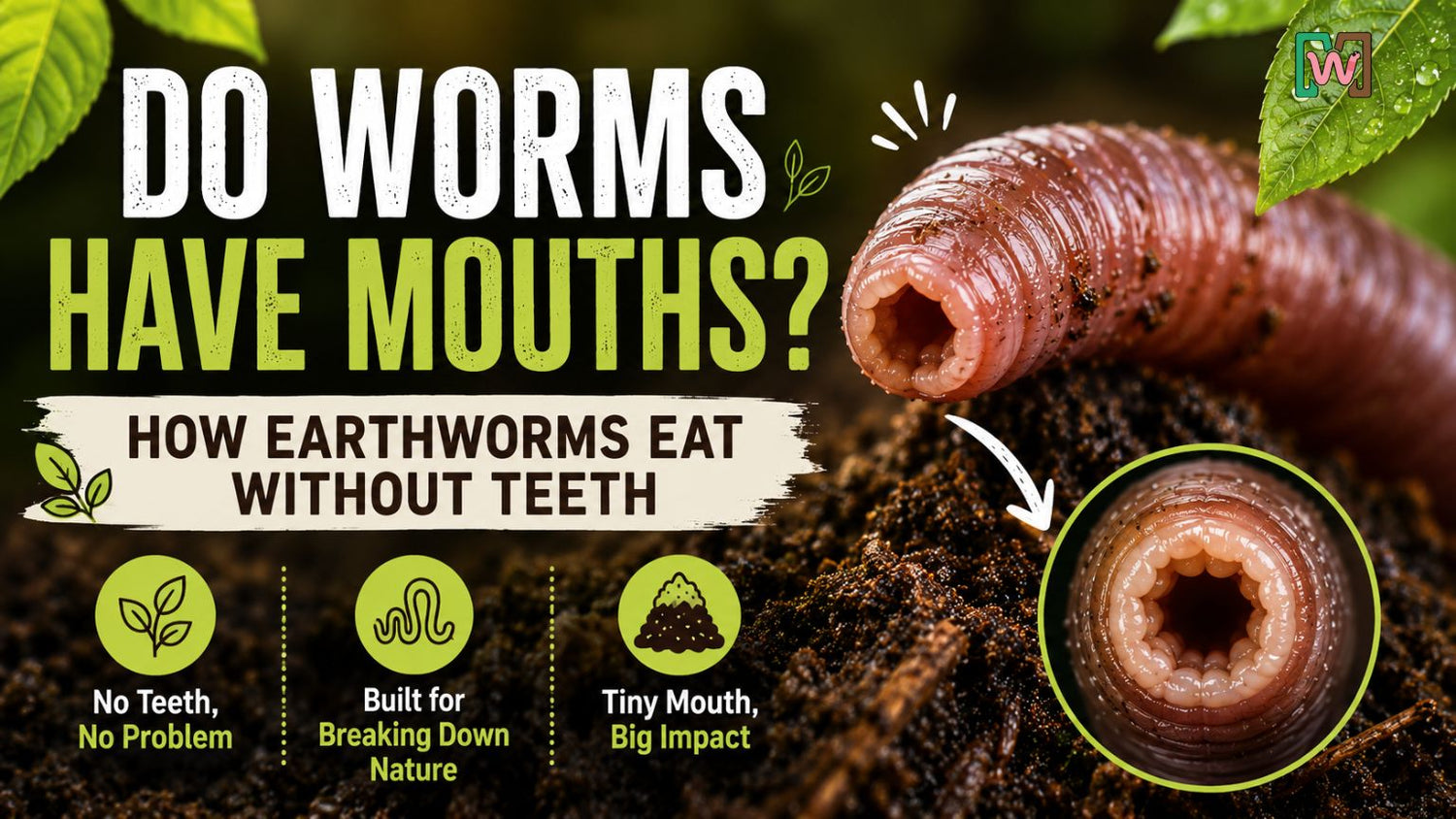
Do worms have mouths? Yes. Every earthworm has one mouth at the front of its body. But it has no teeth and no jaw, and that single fact decides what you should and should not put in your bin.
Do Worms Have Mouths?
Yes. One mouth, at the very front, on the first segment of the body.
It is small and easy to miss. There is a little fleshy flap just above it called the prostomium, which acts like a lip and a feeler at the same time. The prostomium pushes into material, senses chemicals, and helps guide food into the opening below.
What a worm does not have:
- Teeth
- A jaw
- A tongue
So the mouth cannot bite, tear, or chew. It can only suck.
Must Read : Do Worms Have Brains? What a Worm Can and Cannot Learn
How a Worm Eats Without Teeth
The mouth pulls food in using muscle, not cutting. Behind the mouth is a muscular tube called the pharynx that works like a small pump. It creates suction, and soft material gets drawn in.
That is the whole intake system. Suction, nothing else.
Which means a worm can only eat material that is already soft enough to be sucked in. A worm physically cannot get a bite out of a firm raw carrot. It has to wait for microbes to break the carrot down until the outside goes soft, and only then can it start feeding on the surface.
This is the single most useful thing to understand about worm feeding. Worms do not really eat your food scraps. They eat the microbes growing on your rotting food scraps, plus the softened material around them.
The Cornell Waste Management Institute makes this same point about vermicomposting: worms feed largely on the microorganisms colonizing decomposing organic matter.
Where the Grinding Actually Happens
If there are no teeth in the mouth, how does anything get ground up?
Further down. A worm's digestive tract runs in a straight line from front to back, and grinding happens in the middle of it.
- Mouth — sucks in soft material
- Pharynx — pumps it inward
- Esophagus — passes it along
- Crop — stores it temporarily
- Gizzard — grinds it using swallowed grit
- Intestine — absorbs nutrients
- Anus — castings come out
The gizzard is the part doing the work teeth would do. It is a muscular chamber that squeezes food against tiny hard particles the worm has swallowed. Sand, fine soil, crushed eggshell, rock dust. The grit acts like millstones.
No grit means a weak gizzard and poor castings. This is why I add a small amount of crushed eggshell or rock dust to my bins on a regular basis. It is not for calcium alone. The gizzard genuinely needs something hard in it to function.
Must Read : Do Worms Feel Pain? An Honest Look at What Science Knows
What This Means for What You Feed
Here is how the mouth-and-gizzard setup translates into real feeding rules.
Chop everything smaller than you think you need to. More surface area means more room for microbes to grow, which means the material softens faster and the worms can start sooner. I aim for pieces no bigger than a quarter.
Let the food rot a little first. Fresh scraps are not worm food yet. Some people keep a bucket of scraps for a few days before feeding. Slightly broken-down material disappears far faster than fresh.
Bury it, do not pile it on top. Buried food stays damp and grows microbes faster. Food sitting on the surface dries out and attracts flies.
Skip anything hard and dense. Whole carrots, potato chunks, corn cobs, avocado pits, and citrus rinds all sit there for weeks. Not because worms refuse them but because there is nothing soft enough to suck in.
Do not overfeed. The crop only holds so much. Adding more food does not speed up processing. It just leaves extra material sitting around going sour, which drives worms away from that part of the bin.
My rule is simple. Feed again when about three quarters of the last feeding is gone. If you are not sure, wait.
How Much Can a Worm Eat?
Under good conditions, a pound of composting worms will work through somewhere around half their body weight in food per day. Some sources quote higher numbers, and you will occasionally hit them in a perfectly run bin at ideal temperature. Half a pound of food per pound of worms per day is a realistic planning figure.
Actual speed depends on:
- Temperature, with the sweet spot around 65 to 75 degrees Fahrenheit
- Moisture, which should feel like a wrung-out sponge
- How small the pieces are
- How far along the decomposition already is
- Whether there is grit available for the gizzard
Cold bin, big chunks, and no grit will slow everything down no matter how many worms you have.
Must Read : Are Worms Insects? Why the Answer Matters When You Buy Worms
Why Worms Swallow Soil
Worms deliberately eat soil and fine grit along with their food. This is not an accident.
Part of it feeds the gizzard, as described above. Part of it is that soil itself contains organic matter and microbes worth eating. And part of it is simply that a burrowing animal moving through soil is going to take some in.
This is also why worm castings are so useful in the garden. What comes out has been ground fine, mixed thoroughly, and passed through a gut full of beneficial microbes.
Does a Worm Have More Than One Mouth?
No. One mouth at the front, one opening at the back, and a single straight tube in between. Food only travels one direction.
I have also been asked whether worms absorb food through their skin. They do not. Worms breathe through their skin and eat through their mouth. Those are two separate systems that get mixed up often.




Leave a comment
All comments are moderated before being published.
This site is protected by hCaptcha and the hCaptcha Privacy Policy and Terms of Service apply.